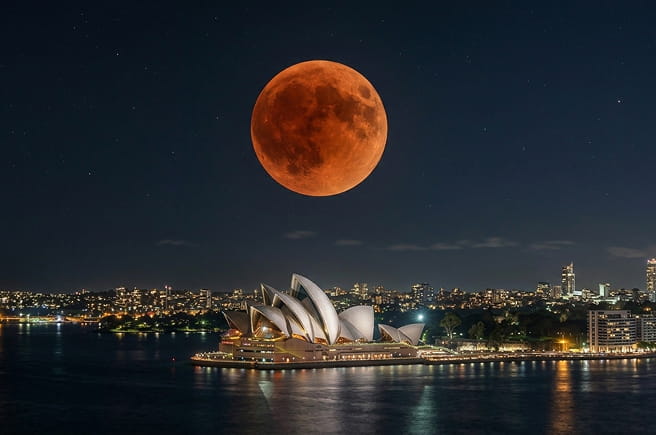
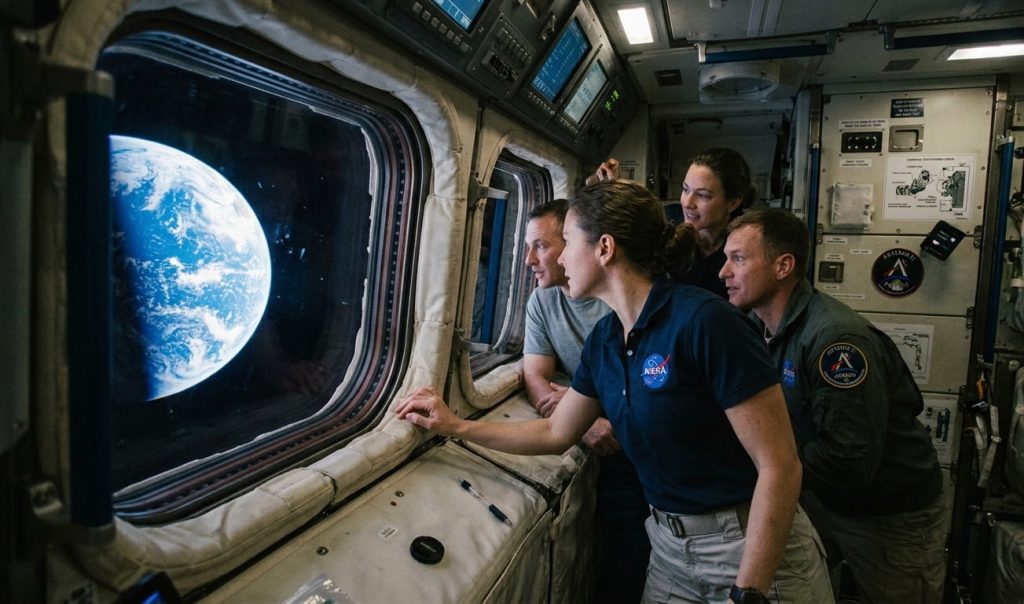
Australians are set to witness a spectacular celestial event next week as a rare “Blood Moon” total lunar eclipse glows across the night sky on March 3, 2026. The event will see the Moon turn a deep copper-red colour as the Earth moves directly between the Sun and the Moon, casting a shadow that fully engulfs the lunar surface.
The total lunar eclipse will be visible across all of Australia, making it one of the most widely observable astronomical events of the year.
How Long Will the Blood Moon Last in Australia?
The eclipse itself is a one-night event, but the full process unfolds over several hours.
- The partial eclipse phase will begin earlier in the evening.
- The most dramatic phase — known as totality — will last approximately one hour nationwide.
During totality, the Moon is completely immersed in Earth’s shadow and takes on its famous red glow.
Here’s how timing differs across major Australian cities:
- Queensland (AEST):
- Partial eclipse begins at 7:50pm
- Totality visible from 9:04pm to 10:04pm
- Adelaide (ACDT):
- Partial eclipse begins at 8:20pm
- Totality begins at 9:34pm
- Perth (AWST):
- Totality visible from 7:04pm to 8:03pm
According to Australian National University Astrophysicist Brad Tucker, Western Australia may miss the very beginning of the partial phase due to the later sunset. However, viewers in Perth will still see the Moon emerge from Earth’s shadow during totality.
Why Does the Moon Turn Red?
The dramatic red glow — which gives the event its nickname “Blood Moon” — is caused by a scientific process known as Rayleigh scattering.
As explained by NASA:
- Sunlight appears white but contains a full spectrum of colours.
- Shorter blue wavelengths scatter easily in Earth’s atmosphere.
- Longer red wavelengths pass more directly through the atmosphere.
- The red light bends around Earth and illuminates the Moon.
This is the same effect that makes sunsets appear red. During a lunar eclipse, it’s as if all the world’s sunrises and sunsets are projected onto the Moon at once.
The intensity of the red colour depends on atmospheric conditions. Dust, pollution, or volcanic particles in Earth’s atmosphere can make the Moon appear even darker or deeper red.
How Many Days Will It Happen in Australia?
The total lunar eclipse occurs on one night only — March 3, 2026.
However:
- The eclipse phases will last several hours on that evening.
- The red “Blood Moon” totality itself lasts about one hour.
- No special equipment is required — it is safe to view with the naked eye.
Unlike solar eclipses, lunar eclipses pose no risk to eyesight.
Weather Could Impact Viewing
Heavy rain and cloud cover are forecast in parts of Australia next week, which could affect visibility in some regions. If skies are overcast, viewers can watch a live stream via Time and Date’s online broadcast.
Astronomers say the early evening timing makes this eclipse especially accessible for families and children, as it does not require staying up late.
A Rare Sky Show Worth Watching
Total lunar eclipses do not occur every month. While partial lunar eclipses are more common, a full nationwide-visible totality lasting one hour is relatively rare.
For Australians, this will be one of the most accessible astronomical events of 2026 — requiring no telescopes, no protective glasses, and no special preparation beyond looking up at the right time.
If weather conditions allow, millions across the country will see the Moon glow red — a reminder of the cosmic alignment between the Sun, Earth and Moon.