
As the conflict between Iran and the U.S.-Israeli alliance escalates, the Strait of Hormuz has transformed from a vital global oil artery into the war’s most dangerous flashpoint. Recent analysis and military assessments, detailed in a report by The Hill, reveal why Tehran has successfully choked this waterway and why a U.S.-led naval escort mission—aimed at restoring oil flow—is fraught with extreme risk, potentially setting the stage for a long-term, attritional confrontation.
The strait For nearly two weeks, a narrow passageway connecting the Persian Gulf to the open ocean, has been effectively closed. Through this 21-mile-wide channel at its narrowest point, roughly a fifth of the world’s oil supply normally flows. Today, it is a high-stakes chessboard where Iran holds a geographic and tactical advantage that experts say cannot be easily overcome by even the world’s most powerful navy.
Why the U.S. and Israel Cannot Roll the Strait
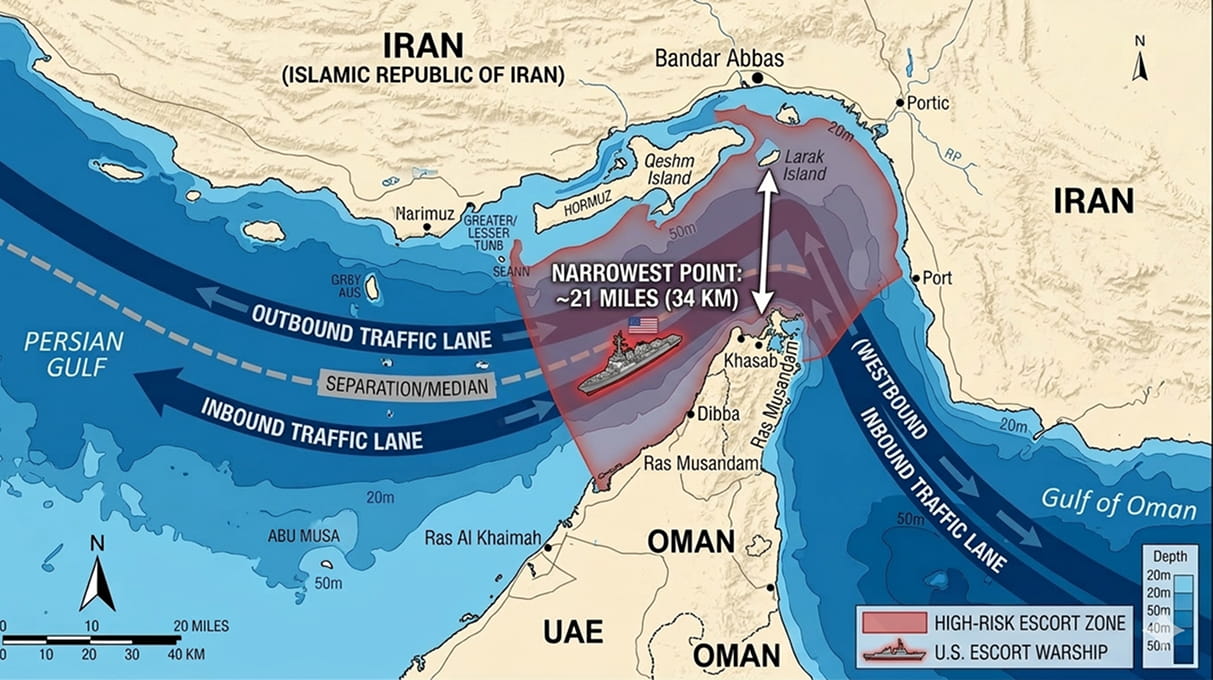
The core reason the U.S. and its allies cannot simply force the strait open lies in the brutal arithmetic of modern warfare in confined spaces. The Hill’s report underscores that the primary threat isn’t just Iran’s navy, but its asymmetric warfare capabilities positioned directly on the coast.
The challenge is going to be dealing with the proximity of the drone launchers and the missile launchers that are going to be along the Iranian coast,” explained Bryan Clark, a naval operations expert at the Hudson Institute, in the article. “You only have a couple of minutes once the launcher comes out before the missiles are going to get on top of you, because you’re only talking about 3 or 4 miles from the shoreline to the transit lane.”
This geographic reality neutralizes much of the U.S. Navy’s technological edge. An escort mission would require placing valuable American warships destroyers, for instance directly in this narrow lane to protect slower, more vulnerable oil tankers. As Rose Kelanic of Defense Priorities pointed out, this creates a paradox: military assets can be more vulnerable than the tankers themselves. A single mine, a low-flying drone swarm, or a shore-launched ballistic missile could inflict significant damage and U.S. casualties in a matter of seconds.
The psychological impact alone has proven effective. Retired Navy Rear Adm. John Kirby noted, “You can shut down the strait through fear alone… In the first few days of this war that’s exactly why the strait was shut down.” Even without constant attacks, the threat has paralyzed shipping, sending insurance rates soaring and oil prices spiking globally.
Iran’s Strategic Role: The Gatekeeper of the “Oil Road
Iran’s strategy is a masterclass in leveraging a geographical choke point for maximum geopolitical and economic impact. By asserting control over the Strait of Hormuz, Tehran is not just disrupting oil shipments; it is directly targeting the economic lifeline of its adversaries and the global market.
The Islamic Revolutionary Guard Corps (IRGC) has made its position unequivocal. A statement attributed to the newly selected supreme leader, Mojtaba Khamenei after Died of Ayatollah Khomeini , declared the strait will remain closed until U.S. and Israeli strikes on Iran cease. The IRGC has reportedly vowed not to allow even a single liter of oil to pass, a threat backed by actions—the article notes at least 19 reported attacks on vessels near the Iranian coast, including strikes by unknown projectiles and mines.
Iran’s role is that of a strategic gatekeeper. It understands that disrupting the oil flow is its most powerful bargaining chip and its most potent weapon. By creating a constant state of fear and uncertainty, Iran can inflict economic pain without needing to win decisive naval battles. This strategy for the long term, a war of attrition that tests the will and resources of the international coalition.
The Prospect of a Long-Term Confrontation
The hesitancy from Washington, despite President Trump’s initial suggestion of naval escorts, confirms the seriousness of the situation. The article highlights that during a classified briefing, U.S. military officials reportedly had “NO PLAN” for safely reopening the strait, according to Sen. Chris Murphy. Treasury Secretary Scott Bessent’s vague timeline—that escorts would begin “as soon as it is militarily possible – further signals the complexity.
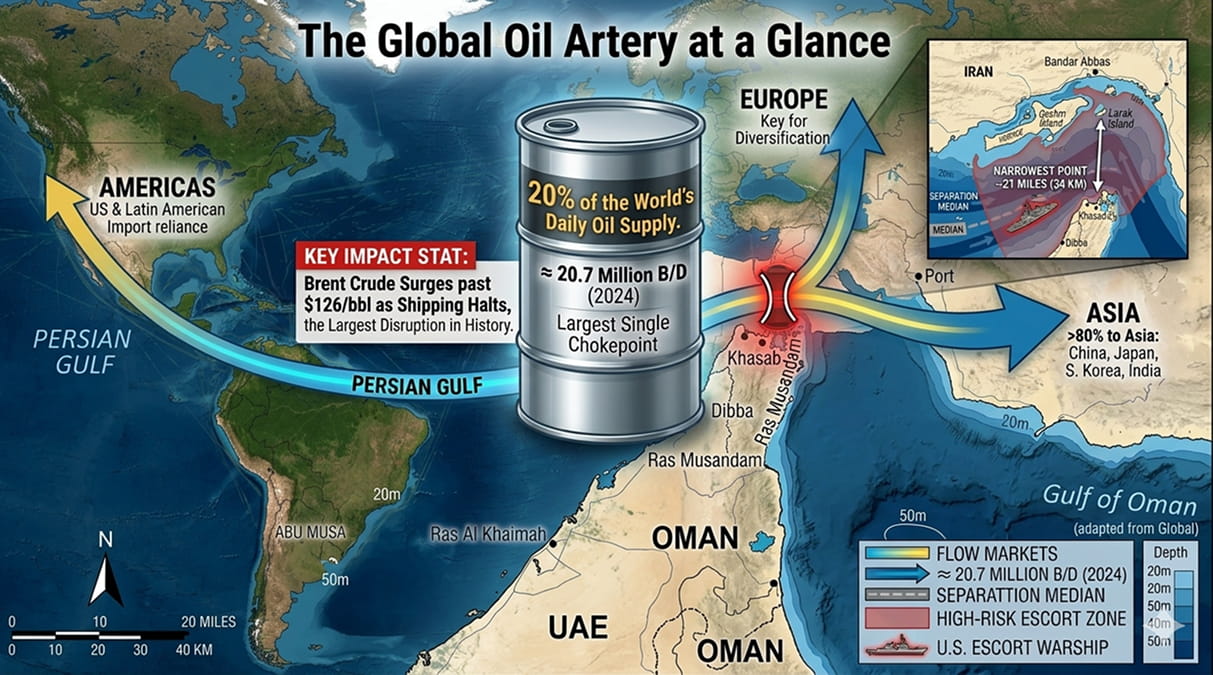
Any escort mission would be an enormous, costly, and continuous undertaking. It would likely require, as Clark suggests, “essentially continuous air patrols above the strait” to preemptively strike Iranian launchers a task easier said than done in such a compact battle space.
Iran, meanwhile, appears prepared for this prolonged standoff. Its forces are dug in, its missile and drone arsenals are substantial, and its strategy is clear: make any attempt to transit the strait prohibitively expensive in terms of military hardware, international political capital, and most critically, human lives. As one expert noted, the current U.S. administration is perceived as very casualty-averse, a sensitivity that Iran is likely banking on.
The Strait of Hormuz has become the central front in a new kind of oil war. Iran’s strategic position, combined with its willingness to employ asymmetric tactics, has effectively neutralized the conventional naval superiority of the U.S. and its allies. now, the world’s most important oil passage remains closed, a testament to Tehran’s ability to turn a narrow strip of water into its most formidable weapon, with the very real potential for a long and grinding conflict.
